Summer Solstice Fire Festivals
Most visitors come to Spain for famous landmarks, world-class museums, and beautiful beaches. But some of the most incredible experiences can happen far away from the main tourist sites.
In the Pyrenees, as the longest days of the year arrive, entire villages gather for a tradition that has connected communities to the mountains for centuries. As darkness falls, lines of people carrying burning torches descend from the mountaintops, creating rivers of fire that wind their way toward the village below.
These are the Fallas of the Pyrenees, a UNESCO-recognized summer solstice fire festival unlike anything most travellers have ever experienced.
What Are the Fallas?
Every year, around the summer solstice and continuing through July, villages across the Pyrenees celebrate the arrival of summer with the Fallas (pronunciation tip: fa rhymes with the word “hi” and the double ll is a “y” — pronounced fi-yas). While each village has its own customs, the heart of the tradition remains the same. Participants (falleros) climb high into the mountains carrying wooden torches (las fallas) made by hand in their communities.
In the weeks leading up to the celebrations, local associations organise workshops where villagers gather to build the fallas themselves. The knowledge of how to select the wood, shape the torches, and prepare them for the descent has been passed from generation to generation.
As darkness falls, the torches are lit and hundreds of people begin their descent toward the village below.
What is remarkable is not just the fire, but the terrain. These are craggy mountain paths that can be challenging enough in daylight. Yet the falleros descend them in near darkness while carrying heavy, burning torches strung over their shoulders, keeping enough distance from the torch ahead to avoid burning themselves while ensuring the glowing snake of fire remains unbroken as it winds down the mountainside.
And it is not only young adults taking part. You’ll see grandparents who have participated for decades, teenagers, parents carrying babies, and even children younger than five proudly carrying their own miniature fallas.
As someone who didn’t grow up with this tradition, every year it takes my breath away. Apart from the beauty of the procession itself, seeing so many people, including children, treating fire in such a respectful way is shocking. All the towns have hoses prepared in case anything should happen, but in general people are very respectful of the fire while still having fun. Seeing parents carrying a burning falla in one hand and a baby in the other, or a kid under ten carrying their own, is something that will never get old, especially for someone who grew up in the US, where fire is treated as something to be feared and restricted, not handed to a child.
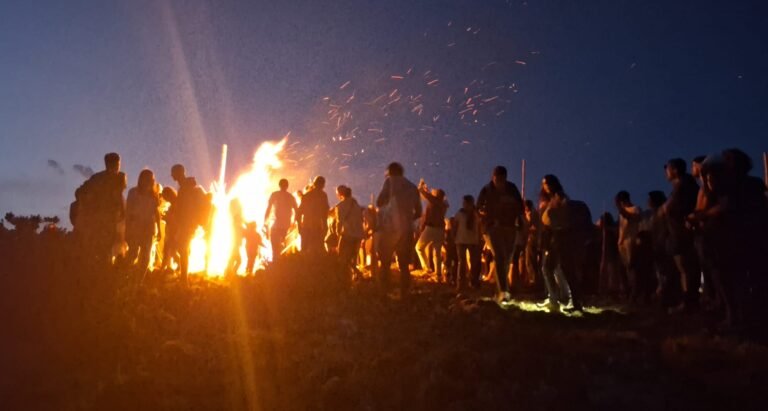
When the procession finally reaches the village, the torches are thrown onto a bonfire. Music fills the square, people dance, kids throw firecrackers, and the celebration continues long into the night.
If you’re in the square as the falleros throw their fallas into the bonfire, you can feel the swell of the fire and the heat on your face. The brisk mountain air can feel chilly in the evening, but as the bonfire grows, that fire gets hot. The next day, you’ll wake up with the smell of smoke still on your clothes and in your hair, a lovely reminder of the fun you had the night before.
A Tradition for the Village, Not the Visitor
Many festivals are designed for visitors. The Fallas exist for the people who live here, and that is exactly what makes them so special for travellers. You are not watching a performance put on for tourists, you are witnessing a living tradition.
In some of the villages that host fallas, fewer than 100 people live there year-round, but entire communities come together: year-round residents, second-home owners, people from neighboring towns, grandparents, parents, teenagers, and children all take part. There are no queues and no timed entry tickets. High on the mountain, the beacon that lights the fallas only gets going once it’s properly dark.
Can Visitors Take Part?
Yes, but being a spectator can be an equally immersive experience. Some of these villages are so small that there’s little separation between participants and spectators. One moment you’re watching, the next you’re chatting with locals, sharing a drink, clapping and laughing together.
Finding Reliable Information
One reason the Fallas remain relatively unknown outside the Pyrenees is that information can be surprisingly hard to find. Dates are often confirmed only a few weeks in advance, and celebrations are scattered across villages in both Aragón and Catalunya, with no single source covering them all.
Experiencing the Fallas from Casa Puixico
At Casa Puixico, we believe the most memorable journeys aren’t measured by the number of places you visit, but by the connections you make along the way. The Fallas are exactly that kind of experience: evenings spent in villages most travellers will never discover, conversations with people whose families have carried these torches for generations, and the feeling of being welcomed into a celebration that exists not for tourists, but for the community itself.
Because of their local, small-scale nature, attending the Fallas can be tricky without local knowledge, and that’s where we come in. Throughout the season, we’re happy to share information about celebrations across this part of Aragón and Catalunya, recommending which villages might suit your interests, and helping with the practical details, from parking to what to wear.
What stays with you isn’t the time spent in a museum queue. It’s standing in a mountain village as dusk falls, waiting in anticipation for the first little falleros to begin their descent down a craggy mountainside. If that’s the kind of travel experience that resonates with you, get in touch through our Experiences page and we’d be delighted to help you discover the Fallas during your stay.
If a description doesn’t do it justice, here’s a short clip.